Our mission at United Neighbors of 1826 is to unite stakeholders in preserving the rural and unique ecological character of the RM 1826 corridor in Travis County through responsible transportation design. We seek to minimize environmental and social impacts while enhancing local access, mobility, and safety. Together, we advocate for alternative transportation solutions other than corridor widening that honor our shared values and enhance the quality of life for all residents along the RM 1826 corridor.
We call for transparency and the halt of TxDOT's only proposed plan for Travis County. We want the opportunity to see and comment on reasonable alternatives to corridor widening per Texas Administrative Code and the National Environmental Protection Agency.
United Neighbors of 1826 is a community organization dedicated to promoting transparency, accountability, and the well-being of residents living near RM 1826 in southwest Travis County.
We strive to ensure that community voices are heard and respected in decisions affecting the safety, mobility, and environmental integrity of the area.
• Seven Homeowners Associations
~ Circle C Ranch
~ Lewis Mountain Ranch
~ Overlook At Lewis Mountain
~ Gallant Fox
~ Loma Vista
~ Meridian
~ Zyle Road
• McKownville
• Right-of-Way Impacted Property Owners
• Grey Rock Golf Course
• JD’s Mall
• Save Our Springs Alliance
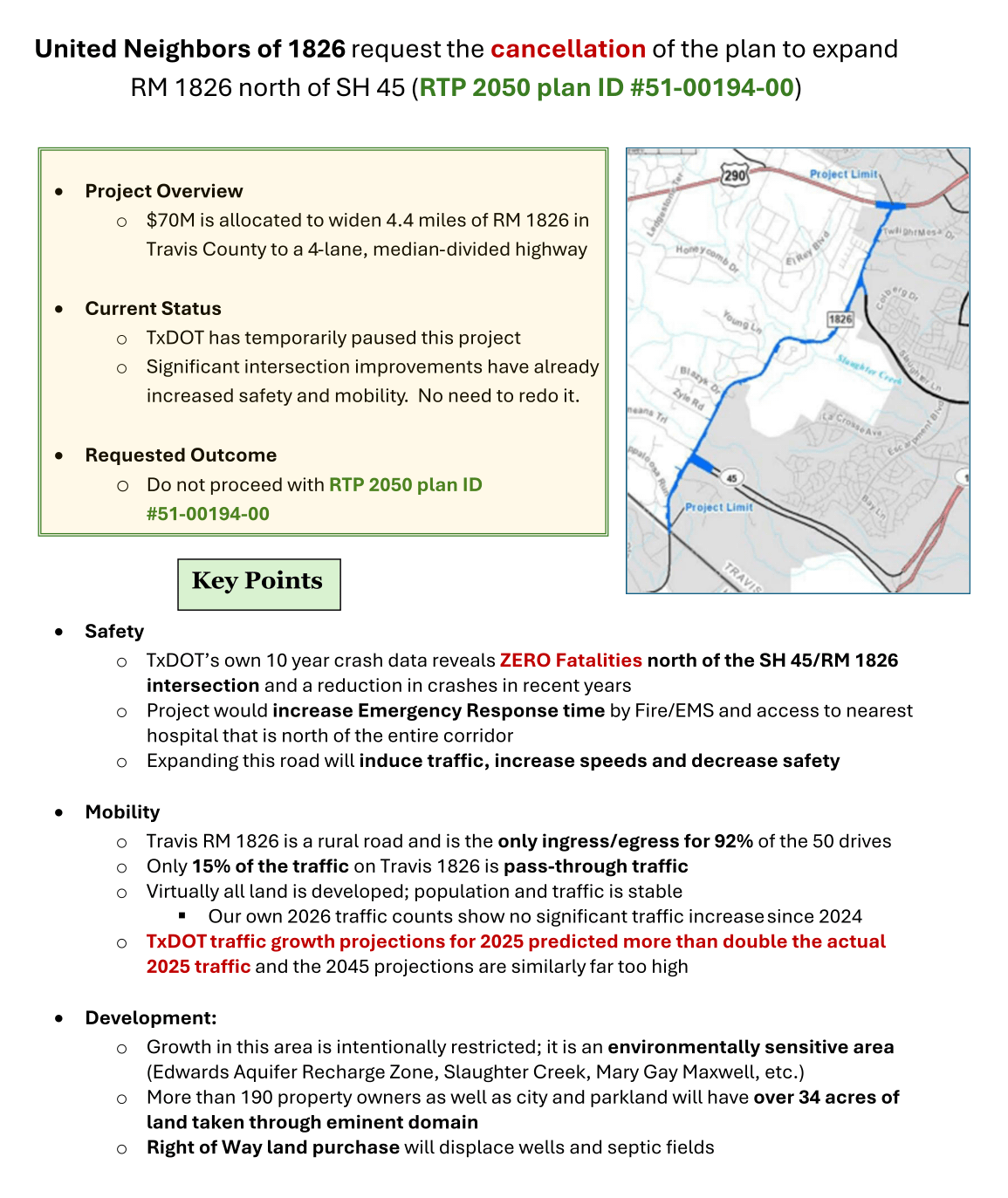
1. Lack of Community Engagement Violated Principles of Procedural Fairness
In January 2024, TxDOT and Travis County initiated advance right-of-way (ROW) acquisition without consulting affected property owners or the broader community. Stakeholders were not invited to participate in discussions about the project’s scope, necessity, or alternatives. They were simply notified.
This top-down approach undermines trust, violates principles of inclusive planning, and gave the clear impression that critical decisions had already been made. It triggered significant and growing community opposition.
2. Community Opposition Fueled by Top-Down Decision-Making
Affected residents were treated as obstacles rather than stakeholders. Early, meaningful engagement could have led to design alternatives, alignment adjustments, or mitigation strategies that preserved community support and reduced impacts.
Instead, the failure to collaborate eliminated the opportunity for practical, less invasive solutions. The RM 1826 project has become a symbol of bureaucratic overreach and a case study in how to alienate the very people a project is supposed to serve.
3. Violation of TxDOT’s Public Involvement Policy
TxDOT’s own Public Involvement Policy calls for early, proactive engagement to improve outcomes and build public trust. However, with RM 1826, public outreach occurred only after key project decisions had been finalized.
While TxDOT may have technically complied with notice requirements and hearings, the absence of true early engagement—particularly before initiating ROW acquisition—violates the intent of its policy and makes public input feel performative rather than meaningful.
4. Flawed Traffic Modeling and Lack of Justification
The project’s justification relies on inflated traffic projections that contradict observed conditions and have not withstood independent scrutiny. For example, when our organization presented data showing significantly lower actual traffic volumes, TxDOT failed to explain the discrepancy or defend its modeling assumptions.
This lack of analytical transparency has eroded public confidence and calls the project’s entire rationale into question. A major infrastructure project should not proceed based on data that cannot be independently verified or logically defended.
5. Opaque and Unaccountable Planning Process
Despite strong community opposition and unresolved technical flaws, there is no clear or accessible process for modifying or removing the RM 1826 project from the UTP, RTP, or TIP. This gives the impression that once a project is added to these plans—often without public awareness or consent—it becomes effectively irreversible.
Such rigidity suggests that public input has little to no bearing on outcomes. This is fundamentally unacceptable in a transparent, accountable, and community-centered planning process.
6. Lack of Transparency in Use of 2023 Bond Funds
In 2023, Travis County voters approved a Capital Improvement Bond that included $25 million for “TxDOT Right-of-Way”—intended to support state road projects. What the public did not know is that this bucket included funds earmarked for RM 1826 ROW acquisition.
At the time of the election, no specific road projects were disclosed, leaving voters unaware that their approval of Proposition A would fund a controversial and largely hidden project. This lack of transparency in public finance undermines trust and highlights the need for stronger accountability in bond program disclosures.
We respectfully request the following actions:
Immediately pause all planning and right-of-way acquisition activities related to the RM 1826 project;
Reallocate Travis County 2023 bond funds designated for RM 1826 ROW acquisition to other projects with clear public support;
Remove the RM 1826 project from:
TxDOT’s 10-Year Unified Transportation Program (UTP)
CAMPO’s 2025–2028 Transportation Improvement Program (TIP)
CAMPO’s 2050 Regional Transportation Plan (RTP)
Establish a transparent, community-accessible process for modifying or removing projects from the UTP, TIP, and RTP; Commission an independent review of the traffic modeling and project justification, and publicly release the findings.
Good morning,
TxDOT and the project team would like to thank you for your interest in the RM 1826 (US 290 to SH 45) project. This project is being conducted to determine possible roadway improvements and right-of-way requirements needed to address future traffic demands and safety improvements within the corridor. Currently, the project remains in the environmental study and schematic development phase of the project development process.
During a recent meeting with community members, we heard additional concerns related to the project timeline, traffic analysis and potential right-of-way impacts. We would like to inform you that the timeline for this project has been extended to allow the project team to collect more feedback before any advancement of this project. This will also potentially include additional traffic analysis and a reexamination of the schematic designs.
Based on these developments, it is anticipated that there will be no right-of-way acquisitions in the next 4 years. Further discussions with property owners about potential impacts will not occur until continued development of the environmental studies and schematic design.
TxDOT wants to reassure community members that there will be future public involvement opportunities to provide additional feedback during the project development process. Your input is critical and will be used to continue informing the development of the project.
We encourage you to share your comments, concerns, and questions through the email below on an ongoing basis:
• Email: AUS_RM1826@txdot.gov
Again, we appreciate your active participation throughout this process and look forward to engaging with the community at future events.
Thank you,
Megan Dutton
TxDOT Advanced Project Development Director
TxDOT Austin District
A Texas Department of Transportation (TxDOT) message
Via email 4/9/2025
Who can I contact at TxDOT if I have questions?
Megan Dutton, P.E.
Project Manager
(737) 272-7027
Megan.Dutton@txdot.gov
Contact these lawmakers to request stopping the RM1826 widening project:
Vikki Goodwin - District 47 Texas House Representative
Paige Ellis - District 8 Austin City Council
Anne Howard - Precinct 3 Travis County Commissioner
Join your neighbors and sign the Change.org!
Rainwater runoff along RM 1826 feeding the Slaughter Creek Watershed. TxDOT's proposed plan would remove these ditches and add significant impervious cover to this area.